
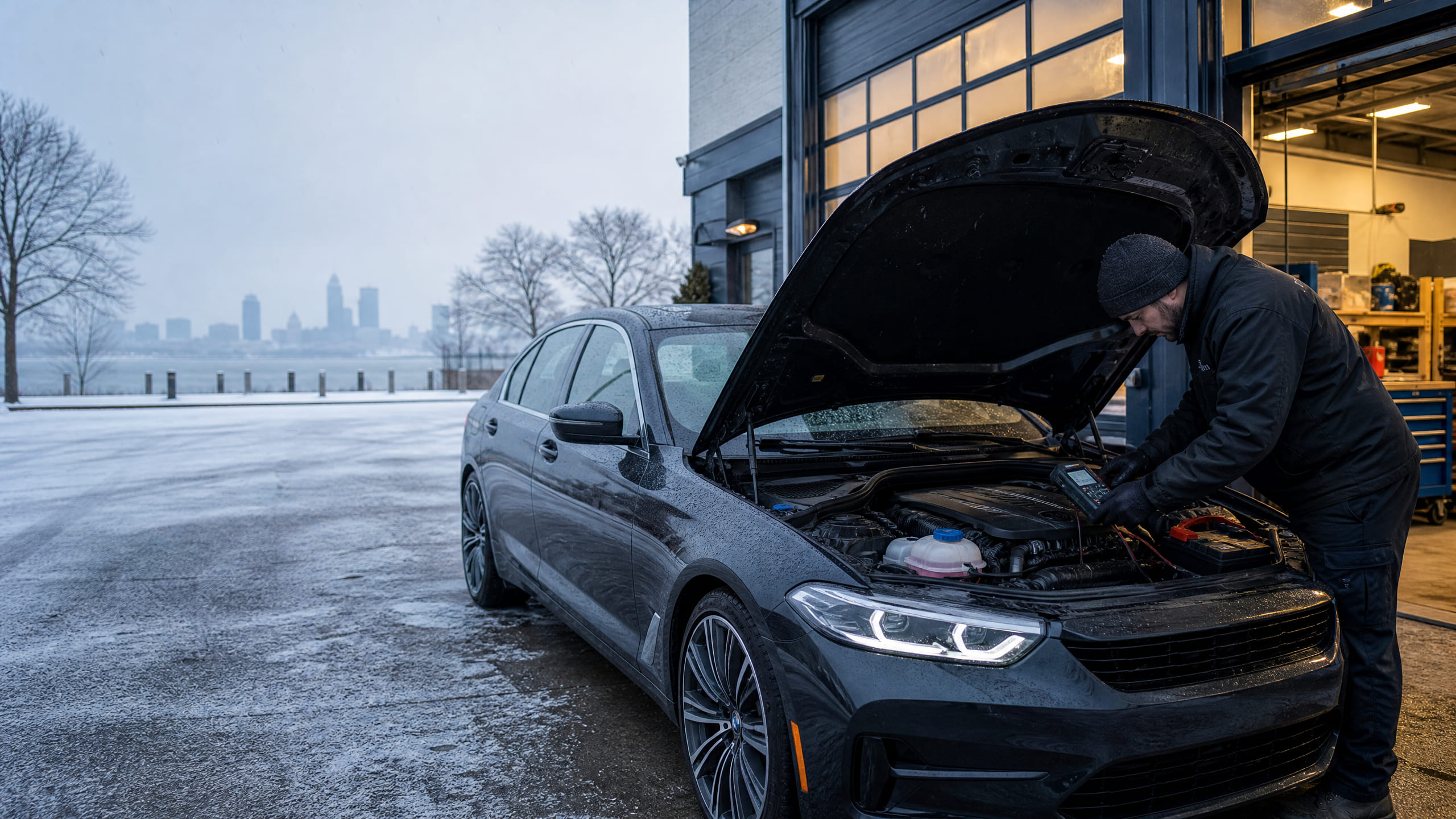
The first hard freeze in Cleveland has a way of finding every weak spot in a car. A battery that felt fine in October will not turn the engine over on a black-ice morning in January. A small coolant leak becomes a cracked expansion tank. Your German car is built to handle winter, but only if a few things are checked before the cold sets in.
We look after BMWs, Mercedes, Audis and other European cars here in Richmond Heights, and the same winter maintenance jobs come up every year. Sort them now, in the mild weeks, and you skip the tow-truck mornings that arrive with the first lake-effect snow. Here is the winter maintenance checklist we run through, and why each item matters more on a German car than on the average commuter.
Start with the battery
Winter maintenance starts with the one part you cannot see working. In cold weather a car battery can lose roughly a third of its strength at freezing, and more than half of it near zero. Now add a BMW or Mercedes full of power-hungry electronics that all draw current the moment you unlock the door, and a weak battery turns into a no-start.
If your car battery is more than three or four years old, have it load-tested before winter rather than after it strands you. The test takes minutes. Replacing a battery on your own terms costs far less than a jump-start on the shoulder of 271 at six in the morning. Many German models also need a new battery registered to the car’s electronics, so it is not a job for a quick parts-store swap.
Switch to the right oil for the cold
Engine oil thickens as the temperature drops, and thick oil is slow to reach the parts that need it most in those first seconds of a cold start. German engines are built around full-synthetic oil for exactly this reason. It stays fluid and keeps protecting in freezing temperatures.
If you are due, this is the moment to book an oil change with the correct winter-grade synthetic for your model. The wrong viscosity makes cold starts harder and wears the engine faster, and the right oil is one of the cheapest parts of any winter maintenance list.
Check the cooling system before it cracks
This one catches a lot of Mercedes and BMW owners off guard. Many of the cooling parts on these cars, including the radiator and the coolant expansion tank, are made of plastic that grows brittle with age and heat. A cold snap is often what finally cracks them, and a failed expansion tank can leave you stranded quickly.
Your coolant, also called antifreeze, needs the right strength to do its job. A proper mix, usually close to fifty-fifty, is what keeps the system from freezing in an Ohio January. That same coolant feeds the cabin’s heating system, so a weak mix can leave the heater blowing cold air just when you need it most. If your coolant is old or has not been flushed in a few years, have it checked and refreshed. While the car is on the lift, we look over the hoses, the water pump and the expansion tank for the early cracks that turn into roadside failures.
Tires, salt and stopping distance
Cold air lowers tire pressure by about one PSI for every ten degrees the temperature drops. Under-inflated tires lose grip right when you need it most, so check the pressures on the first cold morning and top them up. If you drive through heavy snow rather than just cold, a proper set of winter tires is worth it. If your car mostly sits out the worst winter storms, all-seasons in good shape may be enough. That is an honest call based on how much you actually drive in the bad weather.
Then there is the salt. Northeast Ohio roads get heavily salted, and road salt is hard on a car’s underside, its brake parts and its aluminum. Rinsing the undercarriage through the winter slows the corrosion. Cold months also put more strain on the brakes, so if yours are already due, sort them before the ice arrives. Our guide to the signs your brakes need checking covers what to listen and feel for.
Wipers, washer fluid and warning lights
Small stuff, but it is what fails on the worst mornings. Fit winter wiper blades and use a washer fluid rated for freezing temperatures, or the reservoir turns to slush the first time you need to clear salt spray off the glass. And do not brush off a warning light that appears in the cold. Some are just the cold nudging a sensor, but others are the first sign of a real fault. If one comes on, our guide to what your check engine light means is a good place to start.
Book a winter check
The theme running through all of this is simple. Winter does not create new problems so much as expose the ones already there. A twenty-minute look over the battery, fluids, tires and brakes before the cold sets in is the cheapest insurance you can buy, and it heads off the expensive repairs a single cold snap can trigger. If you would rather have the whole list checked in one visit, book a winter inspection with us and we will run through it for you.
Common questions about winter car care
When should I winterize my car in Ohio? Aim for late October or early November, before the first hard freeze. Getting the battery, coolant and oil sorted in the mild weeks means you are not booking emergency work in the middle of a snowstorm.
Do German cars really need special winter maintenance? More than most. The complex electronics lean hard on the battery, several cooling parts are plastic and go brittle with age, and the engines are built for specific synthetic oil. None of it is dramatic on its own, but skipping it is how a small issue becomes a breakdown.
Are winter tires worth it for a BMW or Mercedes? If you regularly drive in snow, yes. Rear-wheel-drive models in particular struggle on all-seasons once there is ice down. If your car mostly stays parked in bad weather, good all-seasons may be enough. It comes down to how you actually use the car.
Do not wait for the first freeze to find the weak spot. Run the winter maintenance checklist above, or bring the car in and we will run it for you, and head into the Cleveland winter with one less thing to worry about.
