
Published
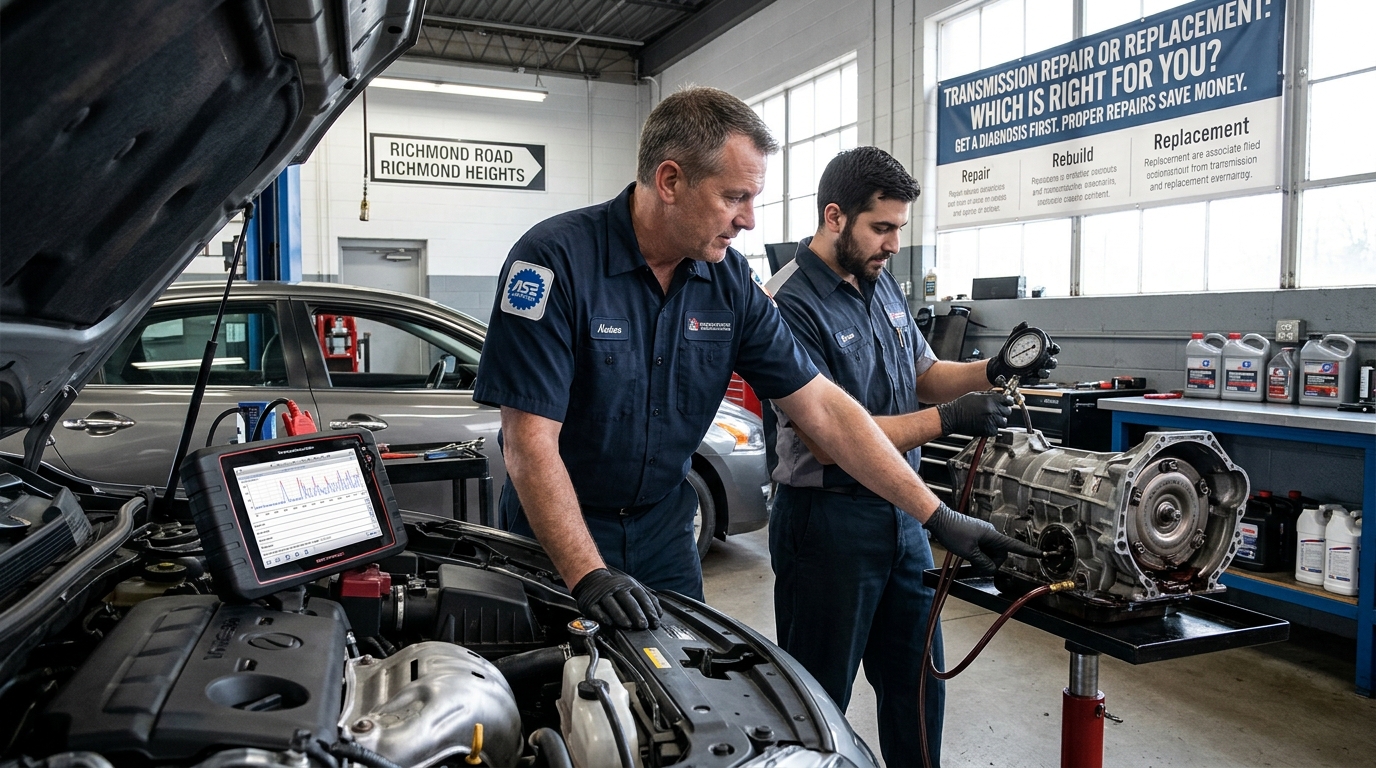
Your car is slipping between gears or stuck in limp mode, and someone has already said “new transmission.” Hold off for now. The choice between transmission repair or replacement usually comes down to whether a single part failed or the damage is inside the gearbox. A proper diagnosis answers that before anyone quotes you for a whole unit.
Our ASE-certified team works on automatic and manual transmissions every week, including the German automatics we specialize in. Before you approve a replacement anywhere, have our transmission team diagnose it first at our shop on Richmond Road in Richmond Heights. Then you will know which part failed and what each option costs.
What is the difference between repairing, rebuilding and replacing a transmission?
A transmission repair fixes the one part that failed, while a rebuild or replacement deals with wear inside the gearbox itself and is a much bigger job. Here are the options from smallest job to largest:
| Option | What it means | When it fits |
|---|---|---|
| Repair | The failed part is fixed or replaced: a seal, solenoid, sensor, valve body or control module | The fault is in the controls, wiring or a leak, and the internal parts are healthy |
| Rebuild | The transmission comes out, gets taken apart and has its worn internal parts replaced | Internal wear, with a case and hard parts that are still usable |
| Remanufactured unit | A unit rebuilt in a factory setting is installed in place of yours | Heavy internal damage, or when you want a unit with a longer warranty |
| Used unit | A transmission from another vehicle is installed | Older cars where keeping the cost down matters most |
A new transmission from the manufacturer is possible on some cars, but it is usually the most expensive route of all. When a repair is not possible, we can install a rebuilt or remanufactured unit, or a new one.
How do you know if a transmission can be repaired?
A transmission can usually be repaired when the fault is in its controls or a leaking seal. Damage to the gears and clutches inside is a different story. Diagnosis tells the two apart. At our shop, we read the stored fault codes, check the fluid level and condition, and run pressure tests before we recommend anything.
What we find in the fluid often settles it. Low fluid from a leak, or a code that points to a solenoid or sensor, usually means a repair rather than a new unit. Metal particles in the pan or burnt friction material point to internal wear. That is when a transmission rebuild or a replacement unit enters the conversation.
Why are German transmissions often repairable without replacement?
German automatics keep much of their electronics and hydraulic control in one assembly that can be serviced on its own. As a result, many failures stop short of the gearbox itself. Two common examples show how this plays out:
- On the Mercedes-Benz 7G-Tronic (722.9), the conductor plate is a well-known failure point. This circuit board carries the control unit and speed sensors. When it fails, the car can go into limp mode or shift harshly. Replacing it is a defined repair that does not need a full rebuild, though a new plate must be programmed to the car before it works.
- On BMWs with ZF automatics, BMW’s own service bulletin for the ZF 8-speed has technicians check the fluid level and condition during diagnosis. The same bulletin notes that a replacement transmission or mechatronic unit (the combined valve body and control module) needs programming. Older BMWs with the ZF 6-speed have a different weak spot: a seal sleeve where the wiring enters the transmission can harden and leak. Fixed early, it stays a seal job.
We handle valve body repair, replacement and programming, the work these failures call for. Still, not every limp mode starts in the gearbox, since a Mercedes can drop into limp mode from something as simple as low battery voltage.
Transmission problems can also turn on the check engine light, according to RepairPal. Our guide to what your check engine light is telling you explains what the light means and when it is safe to keep driving.
What drives the cost of transmission repair or replacement?
The cost of transmission repair or replacement depends mostly on which part failed and whether the transmission has to come out of the car. Our own published range runs from a few hundred dollars to several thousand, depending on the vehicle. These factors move a quote the most:
- The failed part. A seal or sensor costs far less than a valve body, and a valve body costs far less than internal clutches and gears.
- Removal labor. Work done through the pan stays smaller. A rebuild or replacement means pulling the whole unit, which adds many hours on most cars.
- The unit you choose. A used transmission usually costs least up front. A rebuild sits in the middle, and a remanufactured or new unit costs the most.
- Programming and adaptation. German automatics often need the new part coded to the car and the shift points relearned.
- Related parts. A failed unit can leave debris in the cooler and lines, which may need cleaning or replacing to protect the new unit.
Manual transmissions usually cost less to fix than automatics. They are simpler and faster to work on. You will get an estimate from us before any work starts, so the price is settled before the car comes apart.
Is transmission repair or replacement worth it on an older car?
Transmission repair or replacement is worth it when the car is otherwise sound and you plan to keep it a few more years. Compare the quote with what the car is worth running. Then add any other big repairs it is likely to need soon.
Sometimes the honest answer points the other way. Say an older car also has an engine leak and a rusty subframe. Putting a replacement transmission in it can mean spending more than the car will ever be worth to you. In that case, a used unit with a short warranty or selling the car as it is may be the better choice, and we will tell you so.
What warranty should you expect on transmission work?
Warranty terms differ by job and by unit, so ask before you approve anything. Our repair warranty is 12 months or 12,000 miles, with longer coverage available on some jobs, and a used transmission typically carries 6 months.
Ask whether the warranty covers labor as well as parts. Removing and reinstalling the unit is a large share of the bill. A cheaper quote with a short, parts-only warranty can end up costing more than a higher quote with better coverage.
Common questions about transmission repair or replacement
Can a fluid change fix a slipping transmission?
A fluid change can help when the fluid is low or the wrong type. It cannot repair worn internal parts. On a high-mileage transmission that has never been serviced, a change is a judgment call, and our guide to lifetime transmission fluid on BMW and Mercedes covers that decision in detail.
How long does a transmission replacement take?
A replacement on an automatic takes longer than a repair. The timeline depends on how complex the job is and how fast the replacement unit or parts arrive, so ask for a time estimate once the diagnosis is done.
Should I get a second opinion before replacing my transmission?
Yes, especially if the first quote skipped a full diagnosis. Ask which part failed and how it was tested. Then ask why a repair will not work. If a shop cannot answer, get another opinion before you approve the job.
If your car is shifting badly or stuck in limp mode, call us at (216) 486-0890 or stop by our shop on Richmond Road. We will find out whether you need transmission repair or replacement before you spend anything on parts.
