
Published
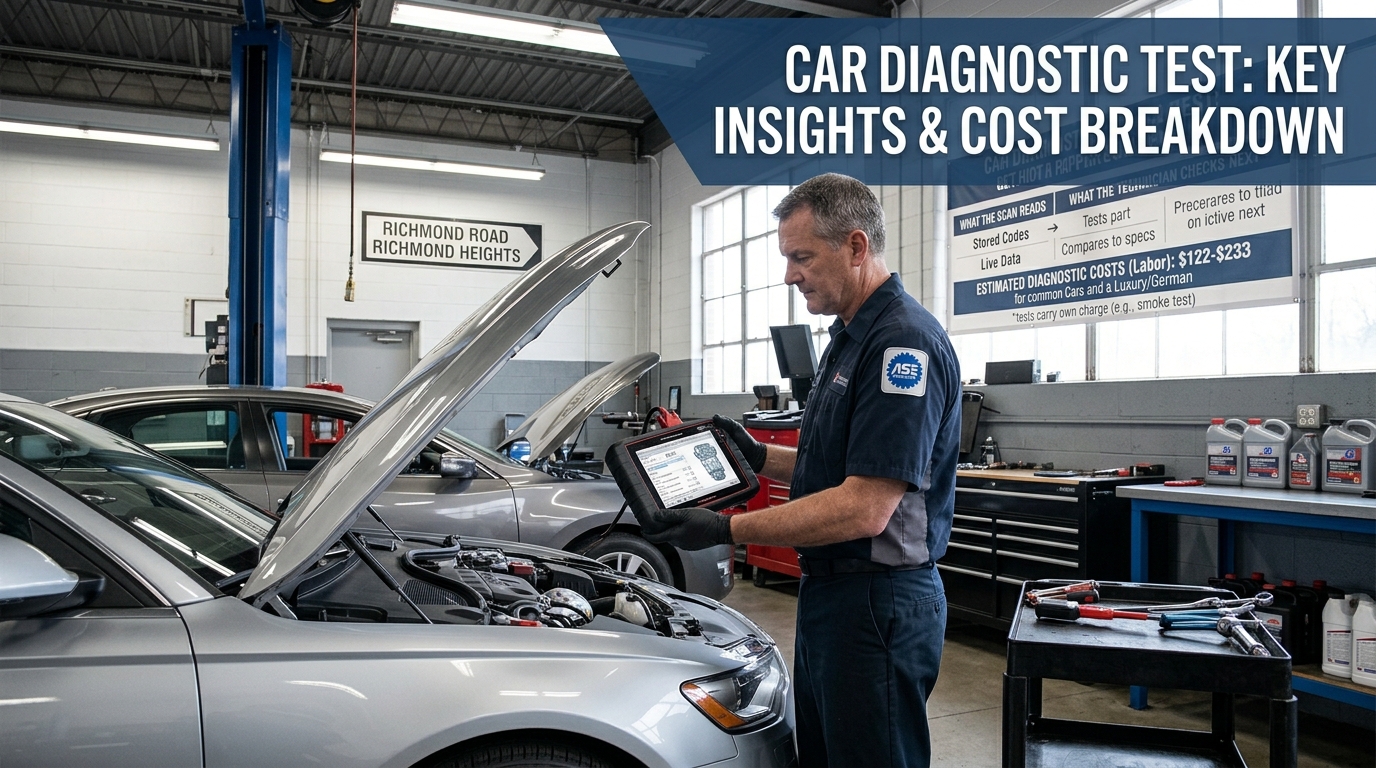
A warning light just came on, and the shop says the first step is a diagnostic. A car diagnostic test is a scan of your car’s computers for stored trouble codes (the error codes many drivers ask about), followed by hands-on testing to find what caused them. Nationally, a check engine light diagnosis runs about $122 to $179 in labor, according to RepairPal, and $159 to $233 on a BMW.
We run diagnostics on BMWs, Mercedes, Audis and plenty of other cars at our shop on Richmond Road in Richmond Heights. Every diagnostic visit with us includes a free 33-point inspection, so if a light is on right now, you can schedule a full diagnostic at our shop and get the rest of the car looked over in the same visit.
What does a car diagnostic test check?
A car diagnostic test reads what your car’s computers have recorded, then a technician tests the parts those records point to. Every car and light truck sold in the US since the 1996 model year has a standardized OBD-II system (on-board diagnostics), which watches the engine and emissions equipment and turns on the check engine light, also called the malfunction indicator light, when something falls outside its limits.
The scan is only the first half. Each piece of information the scan tool reads leads to a hands-on check:
| What the scan reads | What the technician checks next |
|---|---|
| Stored trouble codes | Tests the circuit, sensor or part the code points to |
| Live sensor data | Compares readings with the manufacturer’s specifications while the engine runs |
| Freeze frame data (conditions when the fault was logged) | Recreates those conditions, often on a road test |
| Readiness monitors | Confirms the emissions systems have finished their self-tests |
A code tells you which system noticed a problem, and the testing tells you which part caused it.
Is a free code scan the same as a diagnosis?
A free code scan tells you which diagnostic trouble code is stored, while a full diagnosis finds the root cause. Some parts stores will read your codes at no charge, and that can be a useful starting point. The limit is that one code often has several possible causes.
Take P0420, a common code that flags catalytic converter efficiency below the expected level. A worn converter can set it, but so can a faulty oxygen sensor or a leak in the exhaust system ahead of the sensor, and those repairs differ by hundreds of dollars. RepairPal advises never replacing a part based only on the trouble code, and suggests asking the shop to record every stored code on your repair order. We agree with both, since guessing from a code is how vehicle owners end up paying for parts they did not need.
How much does a car diagnostic test cost?
A car diagnostic test for a check engine light costs about $122 to $179 in labor on many common cars and $159 to $233 on BMW models, based on RepairPal estimates last updated in July 2026. Those ranges leave out taxes, fees and local labor rates, so your quote can land above or below them depending on the type of vehicle and the shop.
German cars sit at the higher end for a simple reason. More control modules and more complex systems mean more time with the scan tool and more tests before the cause is confirmed. Some tests can also carry their own charge, such as a smoke test to find a leak in the fuel vapor (EVAP) system.
Two rules protect you at any shop. According to AAA, a diagnostic fee appears on your bill when a technician uses the shop’s equipment to find the source of a problem, and no shop should do any repair you have not authorized. At our shop, you know the cost before we start any work, and the free 33-point inspection comes with every diagnostic visit.
What should you get back after a diagnostic?
After a diagnostic, you should get a written vehicle diagnostics report and a clear repair plan, even if you decide not to fix anything that day. A diagnosis you cannot read back later is hard to compare with a second quote. Ask for these four things:
- Every stored trouble code, written on the repair order
- The tests the technician ran, with the test results
- The failed part or problem, explained in plain language
- A repair estimate that separates urgent work from items that can wait
That last point is how we run our own diagnostic visits. We explain what we found in simple terms, then sort the repairs by what needs doing now and what can wait, so you can plan the spending instead of paying for everything at once.
How long does a car diagnostic test take?
The scan portion of a car diagnostic test takes minutes, and the full diagnosis usually takes longer because the technician has to test before naming a cause. A steady fault that shows up every time the engine runs is the quickest kind to track down.
Intermittent problems take the most time. Faults in the electrical systems that come and go, and drivability issues such as a stall that only happens on cold mornings, have to be caught while they are happening. If the first block of diagnostic time is not enough, a good shop calls you and explains what is left to test before adding more.
Why do German cars need more than a basic code reader?
A basic code reader sees the standardized engine and emissions codes, which is only part of what a BMW, Mercedes or Audi records. These cars spread their electronics across many separate control modules, including the airbag, ABS and transmission systems, and those faults often need a more capable scan tool to read and clear.
Some repairs on these cars also need software work after the part goes in. A replaced module may need to be coded or re-flashed before it works properly, and our diagnostic service covers computer re-flashes and airbag system diagnostics. For that reason, engine diagnostics on a German car are best handled by a shop that works on these makes every week.
Should you clear the code and see if it comes back?
Clearing a code without a diagnosis usually costs you information and fixes nothing. The freeze frame data that shows when and how the fault happened is erased along with the code, and the technician loses a clue.
Clearing codes also resets the readiness monitors, the self-checks an OBD emissions test looks at. That matters in Cuyahoga County, where E-Check still applies for now. Ohio’s E-Check program tests 1996 and newer vehicles through the OBD system, and a car with its check engine light on cannot pass. Governor DeWine directed the Ohio EPA on September 29, 2026 to begin the process of ending E-Check in Northeast Ohio, but the testing stays in place until that process is complete.
When should you get a car diagnosis?
Get a car diagnosis as soon as a warning light stays on, comes back after clearing, or the car starts making unusual noises or driving differently. A flashing check engine light is more urgent, since it usually points to a misfire, often from worn spark plugs or failing ignition coils, that can damage the catalytic converter, and our guide to what your check engine light is telling you covers the common causes and when to stop driving.
No-start problems need testing too, since a weak battery, a starter and an ignition fault can look alike from the driver’s seat. Our guide to what to do when your car won’t start covers the quick checks worth trying first.
Common questions about a car diagnostic test
Can you do a car diagnostic test yourself?
You can read the codes yourself with a plug-in scanner that talks to the car’s computer, and that is the easy part. On modern cars, finding the cause takes diagnostic equipment, service information and experience with that make, so vehicle diagnostics beyond the code read are usually worth leaving to a shop.
Does a car diagnostic test tell you exactly what is wrong?
On its own, the scan points to a system, not a part. The technician’s testing afterward is what confirms the failed component, which is why a proper check engine light diagnosis costs more than a free code read.
Do I need a diagnostic test if the car seems to drive fine?
Yes, if a warning light is on. A small EVAP leak, for example, may not change how the car drives at all but can still fail an E-Check, and other faults that start quietly can grow into costly repairs.
If a light is on or your car is acting up, call us at (216) 486-0890 or stop by our shop on Richmond Road, and we will find the cause before anything gets replaced.
