
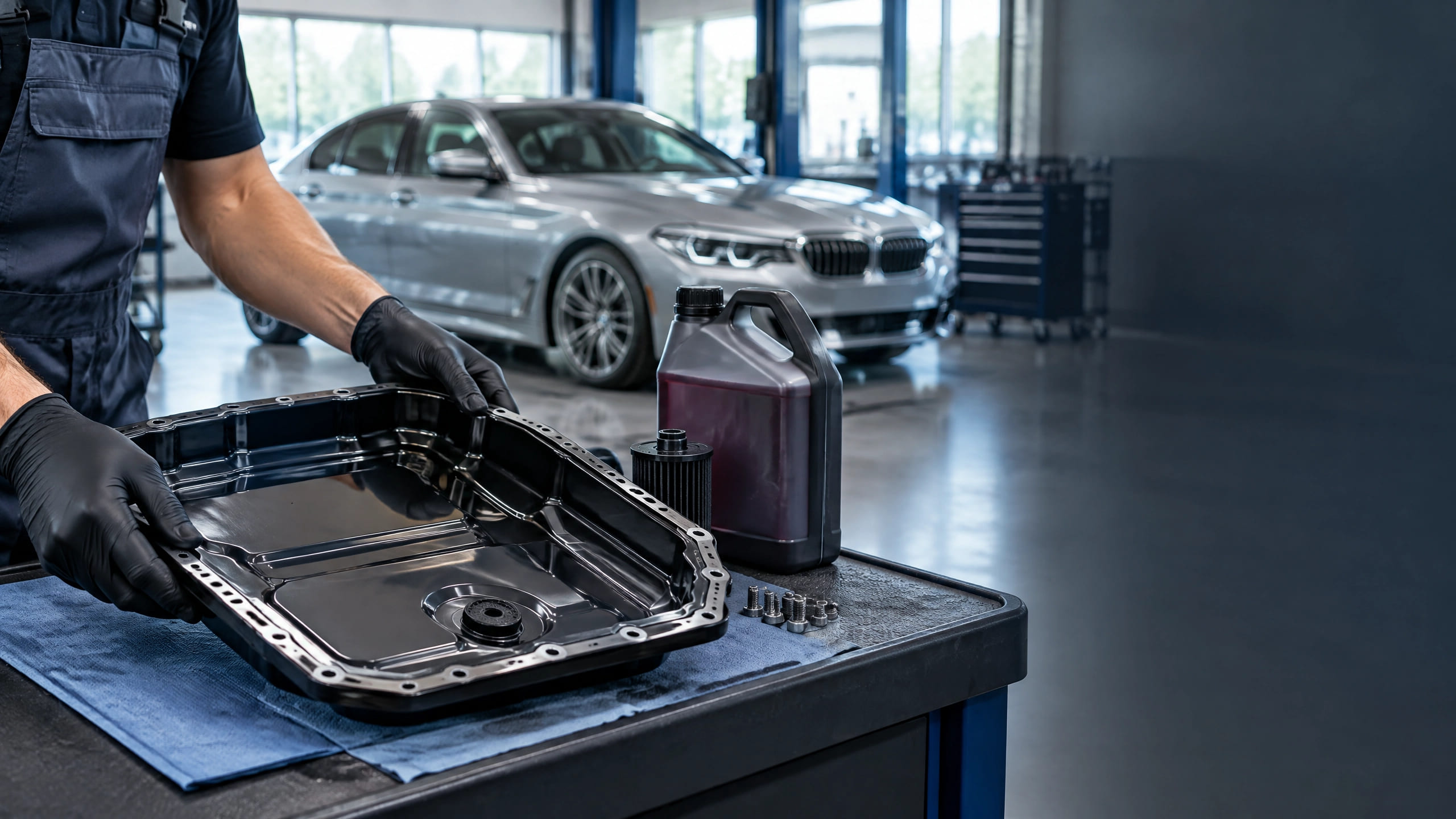
Someone probably told you the transmission in your BMW or Mercedes is filled for life. Maybe it was a service advisor. Maybe it was a post you found online. Either way, it left you wondering whether you ever need to think about it again. The short answer is that you do, and the phrase “lifetime fluid” has cost a lot of drivers an expensive rebuild that a simple service would have prevented.
We work on German cars every week here in Richmond Heights, and tired transmission fluid is one of the most common problems we catch before it turns into a tow. If your car is already shifting oddly, our German transmission service in Cleveland can check the fluid and the gearbox itself in one visit. Here is what “lifetime” really means, when your car actually needs a change, and the signs that tell you it is already overdue.
What “lifetime fluid” actually means
Lifetime does not mean forever. It means it was built to last the expected service life of the transmission under ideal conditions, which the manufacturer usually treats as the length of the warranty. In practice that is often somewhere between 60,000 and 100,000 miles. If you plan to keep your car past the warranty, and most owners do, it needs attention well before the transmission gives up.
There is a reason the label changed. On several BMW models the guidance quietly moved from a set interval to “lifetime” around the time free scheduled maintenance was introduced, with no change to the fluid or the hardware behind it. Read that how you like. The physics did not change. Automatic transmission fluid still breaks down under heat, friction, and time.
Why the fluid matters more in a German car
Transmission fluid works harder than the engine oil most drivers think about. It lubricates the gears, carries heat away, and acts as the hydraulic fluid that supplies the pressure to actually shift the car. As the fluid ages it loses the ability to do all three, and shift quality is usually the first thing to slip. In a BMW or Mercedes running a sophisticated automatic, often a ZF unit, clean fluid is what keeps the whole transmission system cool and shifting cleanly.
Cleveland driving is also harder on fluid than the “normal” driving conditions listed in the manual. Short hops across town, stop-and-go on 271, hills, road salt, and a real Ohio winter all add up to what most makers call severe service. The heat cycling from a cold January start to summer traffic ages it faster than a steady highway commute ever would.
So when should you actually change it?
The right frequency of transmission fluid changes depends on the type of transmission and how you drive, so treat the recommended interval from your vehicle manufacturer as a starting point, not a promise. Newer vehicles complicate it further: many modern automatic transmissions ship as sealed units with no dipstick, which does not mean it never needs service. Here is where the main types land:
- Mercedes-Benz automatics: many owners are advised to inspect and replace the fluid around 40,000 to 60,000 miles under normal use, sooner with towing or heavy city driving. A Mercedes-Benz transmission can be especially sensitive here, since some units rely on a conductor plate that suffers once it breaks down.
- BMW automatics: the transmission’s maker often points to roughly 100,000 miles, while a lot of independent specialists change it closer to 60,000 to 80,000, and earlier on M and performance models.
- Dual-clutch transmissions (BMW DCT, Audi and VW DSG, Porsche PDK): these use their own specialized fluid and usually want service around 40,000 to 60,000 miles.
If you tow heavy loads, sit in traffic daily, or drive the car hard, move to the shorter end of every range. Manual gearboxes are on their own schedule: manual transmissions still use a fluid that wears out, and most benefit from a manual transmission fluid change somewhere around 30,000 to 60,000 miles. Fluid changes sit alongside the rest of your service plan, and our BMW maintenance schedule guide shows where transmission work fits next to oil and brakes.
The warning signs your fluid is already overdue
Mileage is only half the story. The car will usually tell you when it is done. Watch for:
- Rough, delayed, or jerky shifts, or clear gear slippage where the engine revs but the car does not pull.
- A burning smell, which means it has overheated and lost its ability to protect the clutches.
- A change in fluid color. Healthy BMW and Mercedes ATF starts out red or pink, so a dark, brown fluid color means it has oxidized.
- Unusual noises, such as whining, humming, or clunking that grows louder with speed.
- Metal flecks in the fluid, a sign that internal components are wearing.
- Low transmission fluid on the dipstick or a leak under the car, which points to a seal or gasket to fix before the fluid level drops further.
Any one of these is worth a same-week inspection. Ignore them and small issues turn into further damage, then expensive repairs, and eventually complete transmission failure. The gap between a fluid-and-filter service and a full rebuild is enormous, and worn fluid is a common cause of the unexpected breakdowns we see towed in.
Getting it done right on a German car
Two things matter in a proper transmission fluid service. First is the correct fresh fluid and filter to the exact fluid specifications for your model, usually a synthetic transmission fluid built for that gearbox. German automatics are fussy, and the wrong one can cause the very shifting problems you were trying to avoid. Second is a proper fill and, where the transmission calls for it, resetting the adaptation so the gearbox relearns its shift points. A quick drain-and-fill by someone who does not know the platform can leave the unit underfilled or confused, which shortens the life of your transmission instead of extending it.
This is also why the “just leave it alone” advice sticks around. Some shops avoid the job because they are not set up for German cars, so “lifetime fluid” becomes a convenient answer. Staying on top of every fluid is the cheapest insurance you can buy for one of these cars, the same way it pays to keep up with routine oil changes for the engine.
Common questions about German transmission fluid
Is BMW transmission fluid really lifetime? No. No fluid is truly lifetime. BMW’s own guidance points to a change by around 100,000 miles on many models, and plenty of specialists do it sooner. “Lifetime” generally means the life of the warranty, not the life of the car.
How much does a transmission fluid change cost for a Mercedes or BMW? It depends on the model, what it takes, and whether the filter and pan gasket are part of the job. We quote your exact car before any work starts, so you are never guessing.
Can changing old fluid damage my transmission? On a well-kept car, no. On a high-mileage transmission that has never been serviced, a change becomes a judgment call, which is why we inspect the fluid first and talk you through it rather than flushing it blindly.
Do not let a marketing word decide the fate of an expensive gearbox. If your BMW or Mercedes is past 60,000 miles on its original fluid, or showing any of the signs above, book it in and we will check it. Catching worn fluid early is a small bill. A rebuild is not.
