
Published
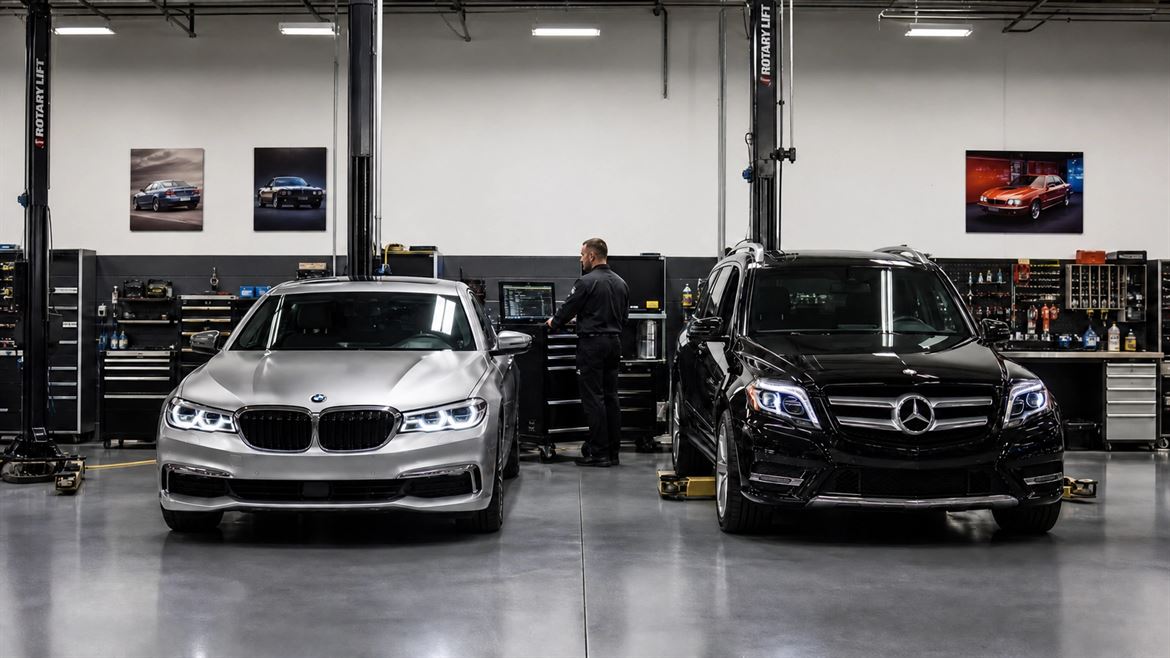
Ask a BMW owner and a Mercedes owner who pays more to keep their car on the road, and you will start an argument that lasts longer than an oil change. The honest answer is that both cost real money, they just spend it differently on maintenance and ownership costs. BMW tends to hit you with more frequent mid-size repairs. Mercedes runs quieter for longer, then sends you one large bill.
We work on both BMW vehicles every week at our shop in Richmond Heights, so this comparison comes from invoices, not internet averages. Here is what owners in the Cleveland area actually pay, and where the dealer-versus-independent gap is biggest.
The yearly picture
Across the first ten years of ownership, most BMW owners land somewhere between $1,000 and $1,700 per year in maintenance and repair costs. Mercedes owners typically see $900 to $1,400. Those numbers look close, and they are, until you look at how the money leaves your account.
BMWs spread the cost out. Valve cover gaskets, engine oil filter housing gaskets, and cooling system parts show up as $400 to $900 jobs every couple of years once the car passes 60,000 miles. Plastic cooling components and gaskets simply age, and Cleveland’s freeze-thaw cycles do them no favors.
Mercedes bills arrive less often but land harder. A car can run near-flawless for years, then need an Airmatic suspension strut or a transmission service on the 7-speed that runs four figures in one visit. Owners who budget monthly for a BMW should budget a reserve fund for a Mercedes to enjoy an exhilarating driving experience.
Where the dealer premium lives
The gap between dealer and independent competitive pricing is not the same on every job. On some work it is modest. On routine maintenance and out-of-warranty repairs, it is often 30 to 50 percent, and sometimes more. One of our customers was quoted almost $3,000 at a dealership for a repair we completed at a fraction of that. That story is common enough that it is practically the business model of every independent German specialist in the country.
Here is how typical jobs compare in the Cleveland market, including maintenance expenses (estimation only):
| Job | Dealer range | Independent range |
|---|---|---|
| Synthetic oil service (BMW or Mercedes) | $180 to $280 | $90 to $160 |
| Front brake pads and rotors | $700 to $1,100 with proper maintenance to keep your vehicle in peak condition | $450 to $750 |
| Spark plugs (turbo 4-cylinder) | $350 to $550 | $220 to $380 |
| BMW valve cover gasket | $800 to $1,200 | $500 to $800 |
| Mercedes transmission fluid service | $500 to $800 | $350 to $550 |
| Coolant system repair (thermostat, hoses) | $600 to $1,000 | $400 to $700 |
Two honest caveats. Dealer pricing varies between stores, and some jobs on some models genuinely belong at a dealer, like open recalls, warranty work, and certain software-locked modules. A good independent shop will tell you when that is the case instead of taking the job anyway.
Why the same parts cost different money
Three things drive the difference.
Labor rate. Dealership labor in the Cleveland area commonly runs $170 to $220 per hour. Independent German specialists usually charge $110 to $150. Same book time, different rate, and on a 4-hour job that alone saves $240 or more.
Parts sourcing. Dealers install parts from the manufacturer’s own box. Independents can install the identical part from the company that actually manufactures it for BMW or Mercedes (brands like Bosch, Lemförder, Mahle, and ZF) without the logo markup. Same factory, same part, lower invoice.
What gets recommended. This one matters more than people think. Dealers work from inspection checklists that generate long recommendation lists. An independent shop that knows your car’s history can separate “needs it now” from “watch it until fall.” That judgment, applied over years, is often the biggest saving of all.
The catch is that these savings only hold when the shop truly knows German cars. Generic quick-service shops using the wrong oil spec or skipping a required electronic reset create expensive problems later. Diagnosis matters too, because guessing at parts on a German car is the fastest way to erase every dollar you saved. When a warning light or drivability issue starts the conversation, proper car diagnostics before any parts are ordered is what keeps a $200 problem from becoming an $800 one.
BMW-specific costs worth knowing
Plan around these once the odometer passes 60,000 miles and your maintenance schedule recommends checking: oil filter housing gasket, valve cover gasket, water pump and thermostat, and front control arm bushings. None of them is a crisis. All of them are cheaper handled early, because a leaking gasket that drips onto a belt or a bushing that wears a tire costs double later.
BMW also launched its Value Service program in 2026, offering dealer maintenance pricing on older cars to win back out-of-warranty owners. It covers a defined menu of basic services, including filter replacements. It is worth comparing line by line, because the menu items are priced to compete while the repairs that follow them are not.
Mercedes-specific costs worth knowing
The big three are Airmatic suspension components on cars equipped with air ride, transmission services that should never be skipped even though some model years were marketed as “lifetime fill,” and engine mounts, which on many Mercedes models are fluid-filled and wear like a consumable. Skipping the transmission service to save $400 is the classic false economy, as small issues can turn into a $4,000 repair.
So which one is cheaper to own?
If you buy with maintenance in mind, a well-kept new BMW or Mercedes with service records usually costs slightly less per year than an equivalent BMW, but carries more single-bill risk. A BMW is more predictable, just busier. Either one, serviced by an independent specialist instead of a dealer, typically saves an owner $300 to $700 per year on routine work alone.
The real cost driver is not the badge. It is whether the car gets the right fluids, on time, from people who work on that engine every week. That is what our team does for German car repair in the Cleveland area, and it is why several of our customers have been bringing the same cars back for over a decade.
Frequently asked questions
Are BMWs more expensive to maintain than Mercedes? Slightly, on average, because repairs often come from the advanced electronics, which can be more costly. Mercedes costs less per year for many owners but produces larger individual bills when air suspension or transmission work comes due.
Do I lose my warranty using an independent shop? No. Federal law protects your rightfinancial commitment to have maintenance done anywhere, as long as the correct parts and fluids are used and documented. Keep your invoices.
Is dealer service ever worth it? Yes, for recalls, warranty repairs, and some software-locked jobs. For everything else, compare quotes.
How much should I budget per year? For a German car past its warranty, $1,000 to $1,500 per year is a realistic planning number at independent rates. Budget less than that and the car will eventually prove you wrong.
)